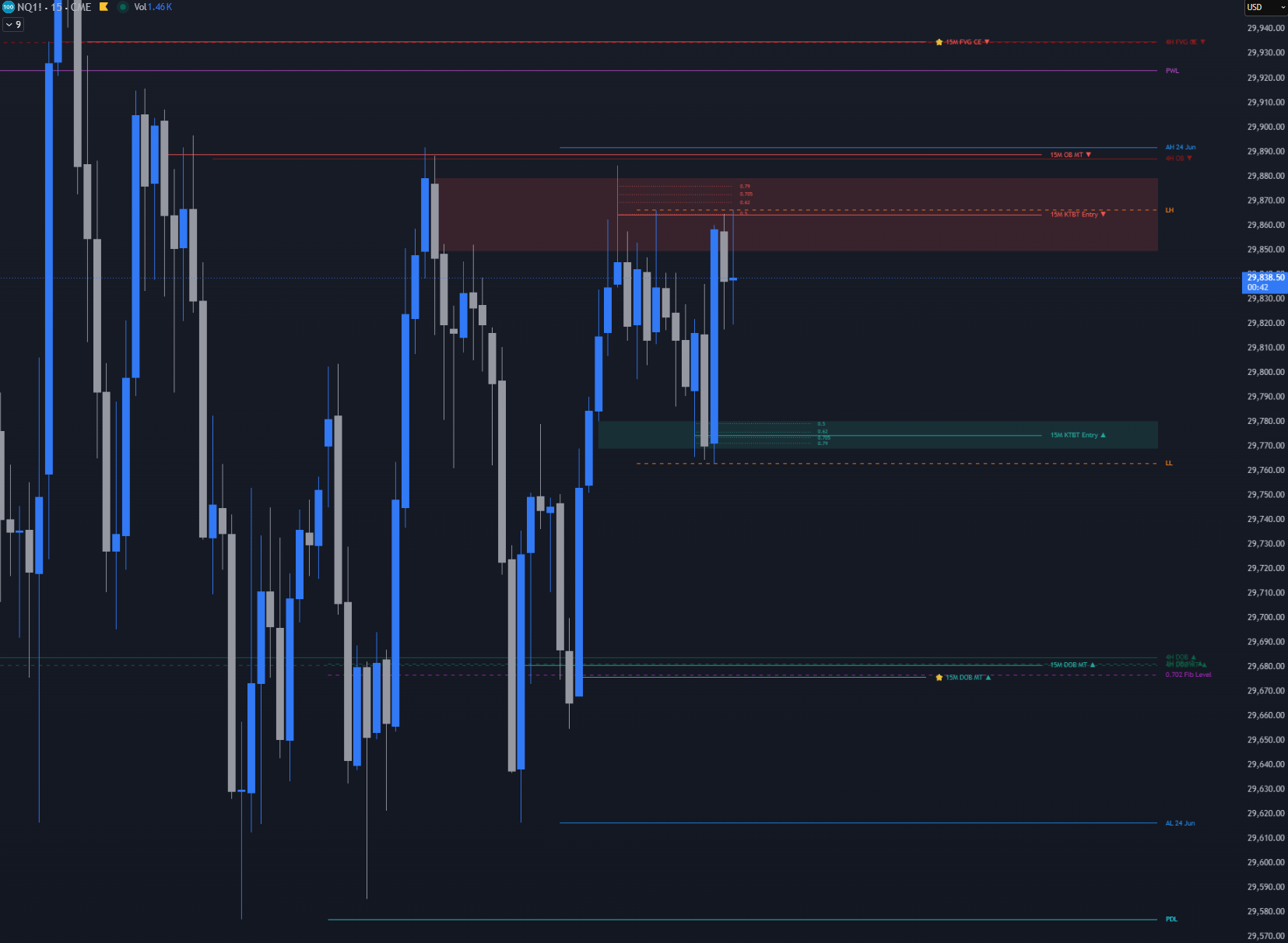
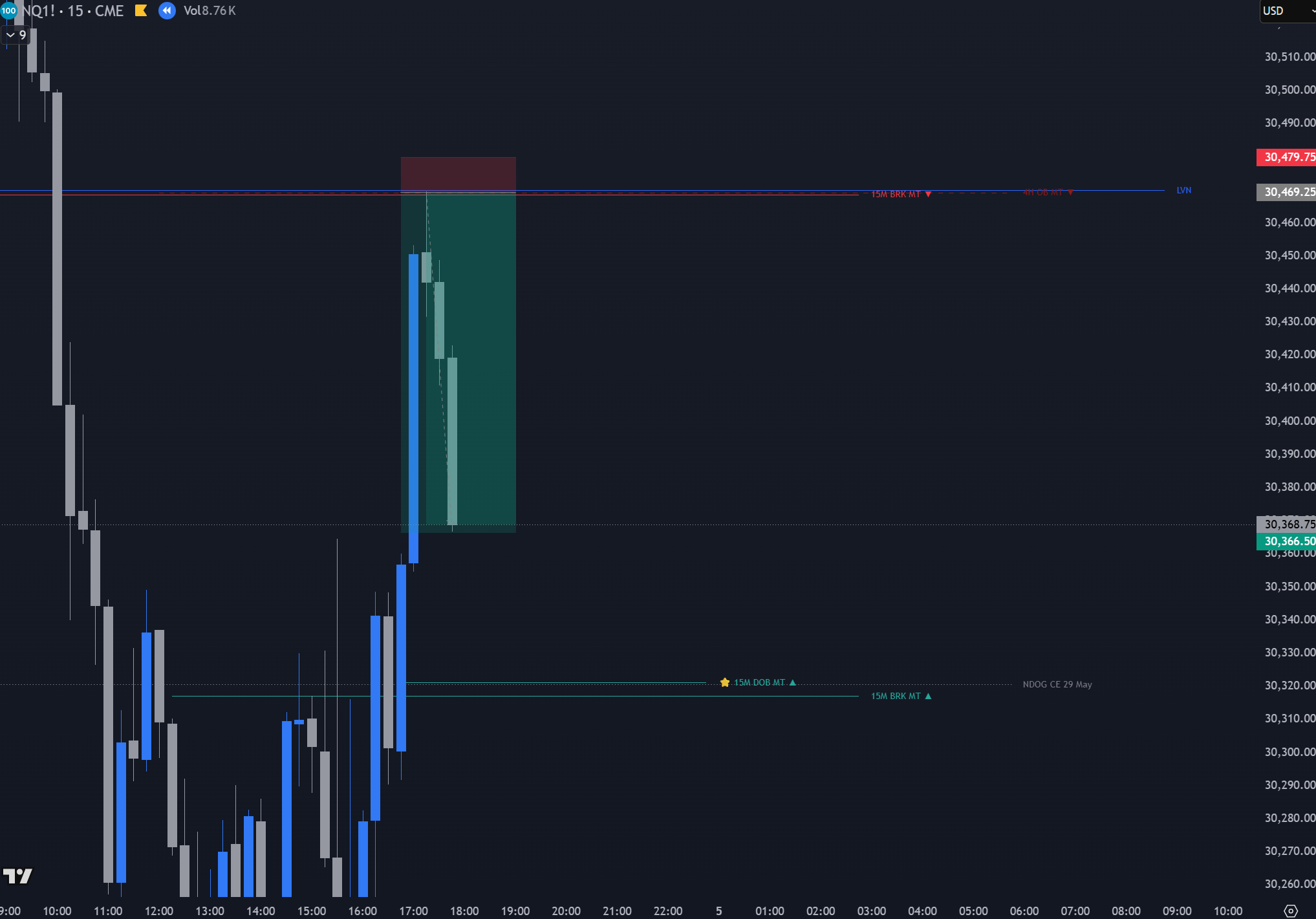
Every order block and fair value gap gets checked against the higher-timeframe pool. Whatever doesn't line up fades; what stays bright is a spot the timeframes agree on — a price you can act on, not a fuzzy zone, with your stop sitting just beyond it. Full takes it from there and walks the rest of the top-down read with you, from the first higher-timeframe glance down to an entry price on the chart. Seven days of the full build for $1.
Order Blocks+MT, DOB
Plotted as prices, not boxes: the mean threshold (MT) and the near edge. Blocks whose breakout left an FVG are tagged DOB — displacement — and a switch hides everything that lacks it.
Fair Value Gaps+CE
Three-candle imbalances, drawn at the near edge and the consequent encroachment (CE) — the gap's 50% level, same math as an order block's MT.
Rejection blocks & entries
Rejection blocks flag the wicks price refused, with the wick's CE as the level to lean on — and STRATA prints a defined entry price right there, refined by an optional OTE Fibonacci on the rejection wick. The full model runs on M15; H1 / H4 / Daily / Weekly add MT-only rejection blocks that form off a same-or-higher-timeframe block or gap. You pick how they're detected — PDA rejection, a strict three-bar swing fractal, or both — and your M15 entries feed the confluence pool, so a higher-timeframe level with a rejection entry sitting on it stays bright. The point is you get a price to act on and a level to set your risk against, not "somewhere in the zone".
Breaker blocks
Order blocks that failed. Once price breaks fully through, demand flips to resistance and supply to support — tracked on M15 by default, H1 through Weekly optional. Continuation levels for when a level you were watching gives way.
Confluence filter
Each order block and FVG is measured against every higher-timeframe block and gap in the pool. If it's within the distance you set of a higher level, it stays bright; if not, it fades. The distance takes decimals, so it works on indices and Forex alike — and what's left lit up are the prices two timeframes actually agree on.
Freshness & mitigation⭐
A ⭐ marks a level price hasn't come back to yet, on M15 and HTF alike; it drops the first time price genuinely returns to it. HTF detection runs on confirmed closes, so nothing repaints on you after the fact. And how a level gets retired is your call: a wick touch, a body-close through the far edge (default), or the stricter CE body-close, where one confirmed close through the midpoint is enough.
5 timeframesM15 → W
Daily and Weekly join M15 / H1 / H4, so confluence is measured against the full top-down context rather than the intraday slice alone.
Any-layering confluenceany level
Lite anchors confluence to M15. Full can drop the anchor entirely: any level checks against any other, regardless of type. An H4 order block against a Daily FVG, a breaker against a session low — with a minimum cluster size you set, only the spots where levels genuinely stack stay bright.
Sessions & key levels
Asia and London with configurable times, plus an optional custom range; session highs and lows plotted as levels. Add NDOG / NWOG, previous day and week highs/lows, and LVNs from a per-day 1-minute volume profile. All of it counts in the confluence pool.
Per-type independent dimming
A separate "dim when not confluent" switch per level type: HTF OB/FVG, breakers, M15 and HTF rejection blocks, wick CE, sessions, fib, opening gaps, previous day/week, LVN. You decide what fades without confluence and what stays bright no matter what.
Daily Fibonacci
Premium, discount and equilibrium over the current day's high-to-low range. Whether a level sits in premium or discount is read straight off the chart, not estimated.
Directional biasdisplay-only
An H4-led read of the delivery, H1 as fallback, shown as a label and optional context box. Display-only by design: it frames the session, it never moves, gates or dims a level.
Alerts
One alert, on purpose: it fires once when a new M15 rejection-block setup forms, and you can hold it to your session window and timezone. The chart calls you; there's no signal feed to babysit.